

Carbon Capture and Storage: Sub-surface Storage
Long term storage of carbon dioxide in the subsurface in the sub-surface is a viable approach to removing the greenhouse gas from our atmosphere and moving it to where a lot of the carbon came from, and where it has been stored geologically for millions of years.
The sub-surface storage should be secure and with minimal leakage paths in order to keep any injected CO2 in place. This sub-surface container needs to have minimal leakage paths and have sufficient overall integrity to achieve its role of keeping the CO2 underground and in place.
For this to be achieved the sub-surface evaluation needs to ensure geomechanical integrity during the injection phase and over the long term storage lifetime. The main analyses to ensure this geomechanical integrity include:
- sub-surface geomechanical characterisation,
- cap rock integrity across the sub-surface formation,
- fault seal integrity, and
- thermo-mechanical response to injection and equilibration.
These analyses need to take into account the factors that will influence the long-term storage capability. Key considerations are:
- the geological history of the sub-surface,
- for depleted reservoirs, the production-depletion history and stress response,
- the horizontal stress variation across the sub-surface formation and caprice/overburden,
- the geological controls on the horizontal stress magnitudes (stress vs strain boundaries)
- the injection strategy,
- old production and new injection well locations, and
- identification of potential leakage paths,
- long-term monitoring, surveillance and verification.
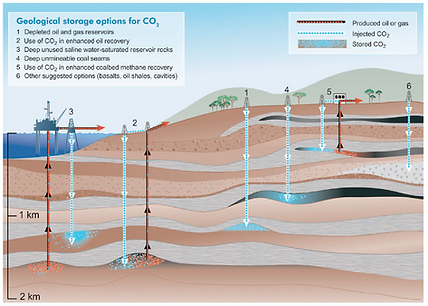
IPCC (2005)
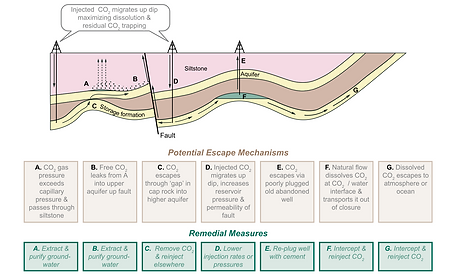
IPCC (2005)

Sub-surface Storage
Make sure the greenhouse gasses stay underground by correctly characterising the injection site and sub-surface storage formation (container) and overburden
Geomechanical Analysis
Four factors to address:
- sub-surface characterisation 1D to 3D-MEMs
- caprock integrity (1D & 3D FEM analysis)
- fault seal integrity (3D analytical and numerical analysis)
- thermo-mechanical response to injection and equilibration
